KS3 Science
Science rewards pupils who can explain as well as recall. We cover the content, then practise writing the answer an examiner would accept, in the right words.
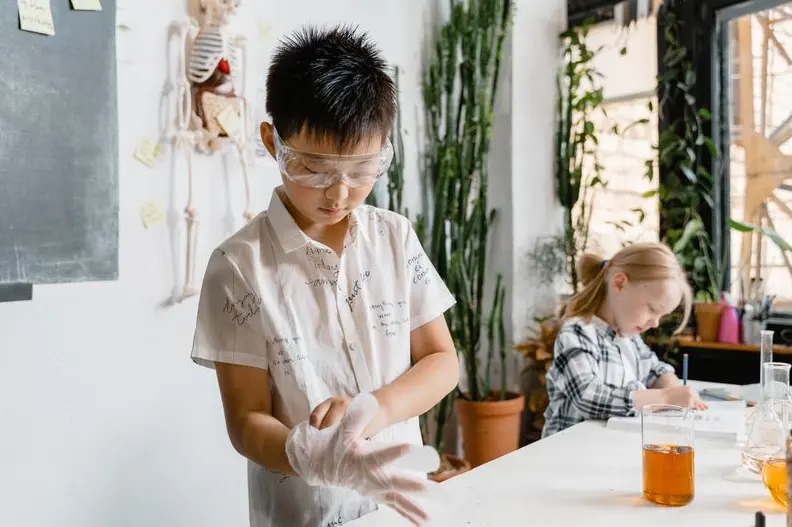
Key Stage 3 science asks a lot of a 12 or 13 year old. Cells one week, the particle model the next, electric circuits the week after, and a test at the end that wants all of it explained in sentences. We teach KS3 science one-to-one, at home or online, for pupils aged 7 to 18, and it is one of the subjects parents ask us about most once their child settles into Year 8.
Here is what our KS3 science lessons cover, who they help, and what happens from the first phone call onwards.
What KS3 science lessons cover
Years 7 to 9 pull three disciplines together and expect pupils to hold all of them at once. Biology takes in cells, organ systems, digestion, respiration, photosynthesis, reproduction, inheritance, ecosystems and health. Chemistry covers particles and states of matter, atoms, elements and compounds, the periodic table, chemical reactions, acids and alkalis, separating mixtures, and the Earth and its atmosphere. Physics brings forces, speed and motion, energy stores and transfers, waves, light and sound, current electricity, magnetism and space.
Running underneath all of it is working scientifically: writing a method someone else could follow, spotting which variable is which, judging whether data is reliable, plotting a graph on the right axes, reading a value off it, describing the pattern and saying how confident you can be. Teachers call this enquiry skills. Pupils tend to call it the hard bit, because it is rarely taught as a subject of its own.
We teach the content in the order your child's school teaches it. Send us the topic list, the knowledge organiser or a photo of the exercise book and we build the lessons around those, so Tuesday's tutoring lines up with Wednesday's science lesson instead of running alongside it. Our tutors are qualified teachers who know the KS3 programme of study well, and every tutor is DBS-checked.
Where the marks are actually lost
Most pupils we meet at KS3 can tell you what happened in the practical. Fewer can write it in the words a marker accepts. "The particles move more" earns one mark. "The particles gain energy and move faster, so they spread further apart and the gas expands" earns three. That gap is where a good share of each lesson goes.
We work through the command words one at a time: describe, explain, compare, evaluate, suggest. Your child sees a full-mark answer, writes one themselves, then marks it while we take a mark off deliberately and ask them to find what has gone missing. It feels slow for a fortnight. Answers usually start filling out on their own after that, without anyone having to say "write more".
Units get the same attention. Writing 5 instead of 5 N loses a mark every time, and so does a line graph drawn through data that should be a bar chart. Small habits, repeated until they stick.
Who KS3 science lessons suit, and who they do not
One-to-one science tuition works best for pupils who:
- understand the lesson in class but come home with tests marked lower than expected
- missed a block of content through illness, a house move or a school change, and are now working around a hole
- will not put a hand up in a class of thirty, so questions pile up quietly
- are coasting in Year 9 and want to be stretched before choosing GCSE options
It suits them less well in a few situations, and we would rather say so early. If you want a cram session the night before an end-of-topic test, a single lesson will not fix a term of gaps. If you are looking for group or classroom-style lessons, we do not run them; every lesson is one-to-one. And we will not write a pupil's homework, project or practical write-up for them. We will show them how to do it, then watch them do it themselves.
How it works, step by step
First contact. Ring or email us with your child's year group, the science topics on the go and anything you have noticed from reports or parents' evenings. We confirm lesson times when you book, and we will tell you honestly whether we have a tutor with the right subject knowledge free.
Initial assessment. Before any teaching starts, the tutor spends a session finding out what your child actually knows. That means talking through recent work, a few written questions across the three sciences, and a look at how they set out an answer. It is not a pass or fail exercise, and pupils tend to relax once they realise that.
A personal learning plan. We write the plan up and send it to you before lessons begin: the gaps we found, the order we will tackle them in, and what a good outcome would look like by, say, the end of term. Our lead tutor reviews every plan before it goes out, which keeps the standard the same whichever tutor you are matched with.
Weekly lessons. Your child gets a regular slot, at home or online, agreed when you book. Lessons are practical and conversational. Expect the tutor to ask "why?" a great deal, and expect your child to write by hand as well as talk.
Progress reports for parents. We send written progress reports covering what has been taught, what has improved and what still needs work. We agree the interval with you at the start so it fits around school reports rather than duplicating them.
Review. At the end of a block we reassess against the original plan. Sometimes the answer is to keep going. Sometimes it is to drop to fortnightly or stop altogether, and we will say that if it is true.
What to have ready before the first lesson
- The school exercise book or workbook, however messy it looks
- The current topic list, knowledge organiser or revision guide the school uses
- Any recent test paper, plus the mark scheme if it came home
- A pen, pencil, ruler and calculator for online lessons
- A table, a lamp and a charged device for online sessions, with the camera on if your child is comfortable with that
- A note of anything the school has flagged about access needs, reading difficulty or extra time in tests, so the tutor can pitch the written work accordingly
For home lessons, a kitchen table and a quiet half hour are enough. Younger siblings in the room make it hard for anyone to think, on a dark January evening as much as any other time.
What affects how long it takes and what it costs
How far behind your child is matters more than anything else. One shaky topic takes a few lessons. A term missed through illness can take a term to rebuild, and we will say which position you are in after the assessment rather than guessing on the phone.
Other things that shift the picture: whether one science needs attention or all three; whether lessons are online or at home, since home visits involve travel across the city; the point in the school year, because a January start has room to breathe while a fortnight before end-of-year exams does not; and whether you want weekly or fortnightly lessons. Year 9 option choices add their own deadline for some families.
Our fees reflect those variables, so we quote on request instead of publishing a flat rate. Ring or email and we will set the fee out plainly before you commit to anything. Nothing is charged for the initial conversation.
Questions parents ask about KS3 science
Do you follow the school's scheme or teach your own?
The school's, wherever we can. We ask for the topic list at the start and check in each half term, because classes move at different speeds and a tutor working from a generic plan quickly becomes irrelevant.
Our child is quiet and hates being put on the spot. Will this be uncomfortable?
Our founder trained as a SENCo, and patience runs through how we teach. Tutors ask, wait, and give thinking time. There is no audience and no raised hands, which is often the reason a quiet pupil says more in a one-to-one lesson than in a whole term at school.
Can you help with all three sciences?
Usually, yes. If your child needs a specialism we cannot cover well, we will tell you rather than stretch a tutor thin. That honesty saves everyone a wasted half term.
My child is in Year 9 and picking GCSE options. Can you help with that?
We can talk through how the sciences feel day to day at KS3 and where the written demands sit, which is often what the decision turns on. The teaching itself still focuses on the Key Stage 3 content.
Is online as good as at home for science?
For KS3, generally yes. Diagrams, graphs and equations work well on a shared screen, and pupils often write more neatly when a tutor can see the page. Practical work stays at school either way, so we teach the method and the write-up rather than the equipment.
From first steps to exam-ready
-
Vocabulary
Cells, particles, forces and energy, defined precisely and used in sentences.
-
Explaining
Writing three-mark answers that name the process, the cause and the result.
-
Working scientifically
Graphs, variables and practical questions, including the ones pupils skip.
Lesson details
- ✓
Topic maps
A one-page summary of each topic, built by the pupil rather than handed over.
- ✓
Exam wording
Practice at the command words: describe, explain, compare, evaluate.
- ✓
Required practicals
The methods and results pupils are expected to know inside out.