KS3 English
Most pupils can talk about a book. Turning that talk into a paragraph with a point and a quotation is the skill we teach, slowly and repeatedly.
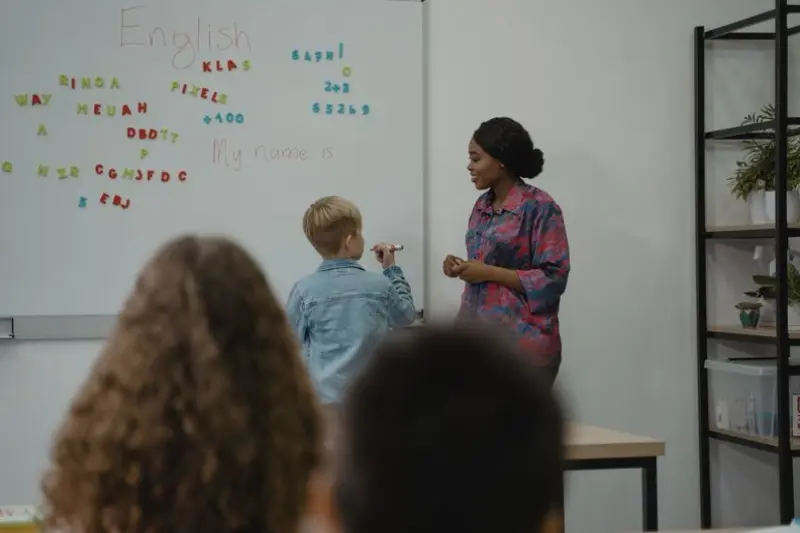
KS3 English is where a pupil's ideas have to start looking like an argument on paper. Most children in Years 7 to 9 can talk about a book or a poem with real insight. Ask them to write it down and the sentence collapses into a retelling of the plot. This page explains how we teach the missing step: a clear point, a short quotation, an explanation that says something about the writer's choice, and a sentence that links back to the question.
We are Brightmark Home Tutors. We teach one-to-one KS3 English at home or online. Every tutor is qualified and DBS-checked, every learning plan is overseen by our lead tutor, and parents receive progress reports. Lessons across the business are for pupils aged 7 to 18; this page covers the KS3 English strand for Years 7, 8 and 9. If your child is in Year 6 or below, our primary and transition pages will fit better.
What KS3 English tuition covers
KS3 English pulls several skills together: reading, writing, spoken language, grammar, spelling and vocabulary. Schools assess them through extended answers. Some follow a thematic curriculum, some teach a 19th-century novel alongside poetry, and some begin GCSE-style questions in Year 9. We fit around what the school is doing rather than running a separate syllabus.
Reading for meaning
We start with the text in front of the pupil. A Year 7 pupil might be reading a class novel; a Year 9 pupil might be working on Macbeth or a war poem. The tutor asks them to find a line that supports their idea, then to explain what the writer is doing with that line. We teach a repeatable paragraph shape: point, evidence, explanation, link. Schools call it PEE, PEEL or something else. The name matters less than the habit.
Writing that holds together
Pupils learn to plan before they write, vary sentence openings, punctuate for clarity and proofread their own work. For pupils who write very little, we build stamina with short timed paragraphs. For pupils who write a lot but lose the question, we teach planning boxes and topic sentences. Spelling and grammar are handled in context, with short drills where one gap keeps reappearing.
Speaking as a bridge to writing
Many pupils can say the idea out loud. We use that. The tutor might ask your child to explain a scene as if telling a friend, then turn the spoken answer into three written sentences. It works well for pupils who freeze at a blank page.
Who it suits, and who it does not
This programme suits pupils in Years 7, 8 and 9 whose written work does not yet show what they understand. Parents often tell us their child contributes well in class but writes plot summaries, or reads widely but loses marks on spelling and punctuation. It also suits pupils who slipped after starting secondary school, when the volume of reading rises and instructions become less explicit.
It does not suit every situation. If your child is preparing for GCSE English Language or Literature in Years 10 and 11, the GCSE page covers that ground. If the goal is 11+ entrance, the 11+ programme is the right fit. If a pupil needs intensive revision in the final weeks before an exam, one weekly lesson may not be the right shape. We teach at kitchen tables across Glasgow's southside, from Shawlands to Pollokshields, and online to families further out. Group classes and worksheet packs are not what we do.
How a place with us works, step by step
You should know what is happening, what it costs and what your child is working on.
- First conversation. We ask about the school, the year group, the text they are studying, recent reports and what you have noticed at home. No preparation needed for this call.
- Initial assessment. A qualified tutor meets your child for an assessment. It usually includes a short reading passage with questions, a piece of extended writing and a conversation about a text they know. For online lessons, we send materials ahead or share them on screen.
- A personal learning plan. We write up strengths, gaps, the two or three skills we will teach first, and how many lessons we suggest. We share the plan with you before lessons begin. Our lead tutor reviews every plan.
- Tutor match. We match your child with a qualified, DBS-checked tutor who knows the KS3 curriculum. If the fit is not right after the first few lessons, tell us and we will change it.
- Weekly lessons. Each lesson has a clear focus, a short recap, modelled examples, guided practice and a task your child completes with support. We ask questions, wait for answers and write alongside them when needed.
- Progress reports for parents. You receive written reports that set out what has been covered, what has improved and what comes next. We agree the schedule at the start.
What your child needs to bring
For home lessons, have the school exercise book, the current class text and recent marked work to hand. Marked work is more useful than a clean textbook because it shows the teacher's comments, targets and mistakes. A recent school report helps too. For online lessons, use a laptop or tablet with a working camera and microphone, a quiet corner, and the text or exercise book open beside them.
We bring the plan, the resources and the tutor's briefing. We also bring patience. A pupil who has decided they are bad at English will not be argued out of that view in one lesson. We start with something they can already do, then add one small step.
What affects timing and cost
Lesson fees are on request. We confirm them before the first lesson, along with the number of lessons we suggest after the assessment. Several things move the plan: how often you want lessons, whether they are at home or online, the tutor's availability around school hours, and how much ground needs covering before a school assessment or the end of term. A pupil working on one text for a Year 8 unit needs a different shape from a Year 9 pupil preparing to choose GCSE options.
Home lessons involve travel, so we group them by area where we can. Online lessons are easier to fit around clubs and commuting. We do not promise a start date until we have checked tutor diaries, and we will tell you if the wait is longer than you want.
Questions parents ask
How is KS3 English different from GCSE English?
KS3 builds the habits that GCSE later assesses. In Years 7 to 9 we focus on reading accuracy, paragraph structure, quotation use, grammar and confidence with longer answers. GCSE work adds exam board mark schemes, timed conditions and set text revision. If your child is already in Year 10, the GCSE page is the better starting point.
Can you help with the specific text my child is studying at school?
Yes, usually. Tell us the title and the year group when you get in touch. We will check that the tutor knows the text and the school's approach. If the school is teaching a modern novel, a Shakespeare play, a poetry anthology or a class reader, we plan around the classwork rather than adding a second, unrelated text.
My child is anxious about writing. What happens in the first lesson?
The first lesson is an assessment, not a test to pass. The tutor will talk to your child, read a short passage together and ask for a few sentences. Short answers are fine. We are looking for what they can do and where the gap sits. If your child is very reluctant, we can split the assessment into two shorter sessions.
How will I know it is working?
You will see the written plan before lessons begin and progress reports after that. Look for smaller signs too: your child talking about a book without being asked, or explaining a quotation at the kitchen table. We report on skills and next steps, not on promises about grades. If the plan is not fitting, we change it.
From first steps to exam-ready
-
Close reading
Picking out a quotation and saying something specific about the word choice.
-
Structuring a response
Point, evidence and explanation, practised until it becomes habit.
-
Analysing style
Writing about structure, form and effect with the vocabulary to do it.
Lesson details
- ✓
Feedback on writing
Every piece is marked with two things to keep and one to change.
- ✓
Wider reading
Short extracts from poems, articles and novels to build a store of examples.
- ✓
Grammar checks
Sentence variety, tense and punctuation, corrected in the pupil's own work.